The Long Road Back · Sayers & Potter
Two Stories.
One Run.
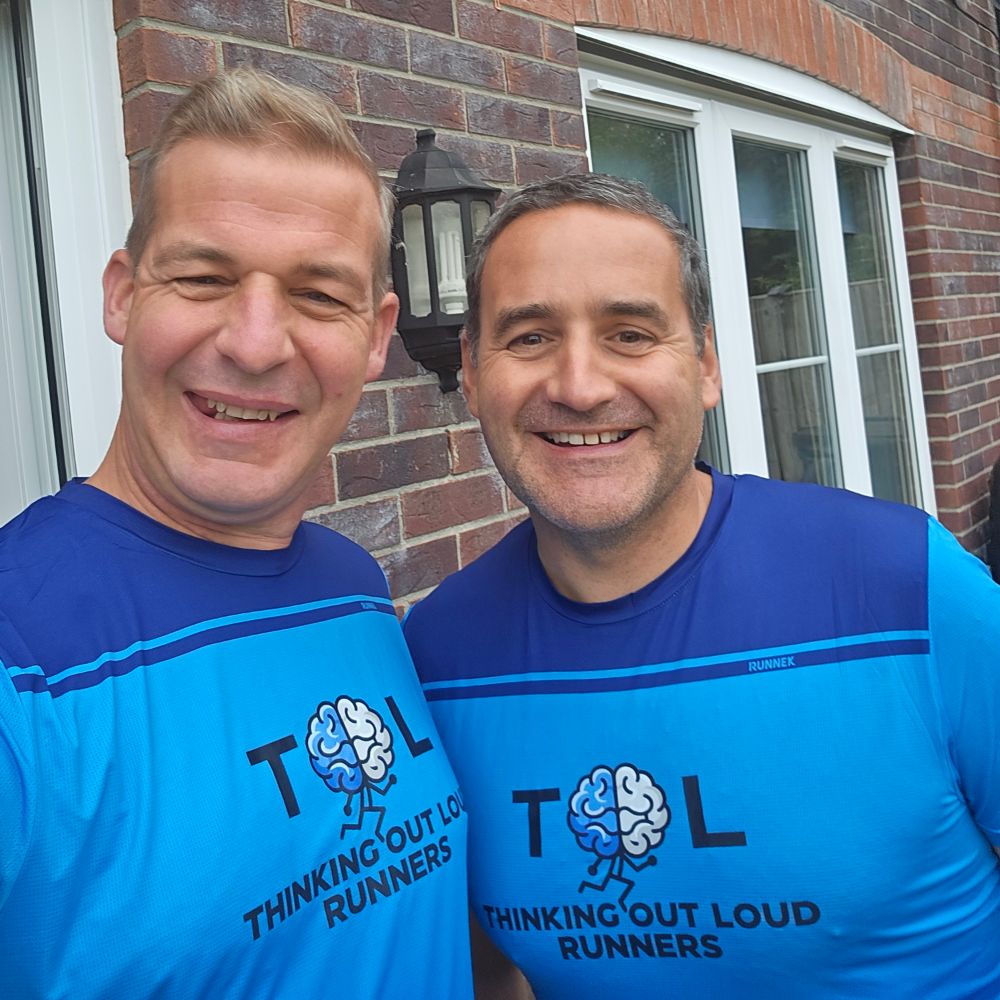
Two friends. Two hospital wards. 350+ miles from the Jurassic Coast of Dorset to the Arc de Triomphe in Paris.
This run exists because two people who know what it’s like to sit in a hospital ward, wondering what comes next, decided they wanted to do something about it.
Not a charity walk. Not a sponsored silence. A run — 350+ miles, on foot, across twelve consecutive days through England and rural France. From Bucky Doo Square in Bridport to the Arc de Triomphe in Paris.
The route passes through Dorset County Hospital on the UK Day — through the wards that looked after both men. It crosses the English Channel on the overnight ferry from Portsmouth. It follows ancient Norman roads through D-Day country — the same corridor that has carried armies, kings and history for a thousand years. Through Bridport's twin town of Saint-Vaast-la-Hougue, through Bayeux, where a 70-metre tapestry tells the story of the last time this crossing changed the world. Past Falaise, where William the Conqueror was born. Along the Seine into the French capital. It finishes at the most photographed monument in the world.
But the reason it exists begins in two hospital beds, and in a friendship that didn’t wait for either man to be well before it started making plans.
“The idea started after James’s first hospitalisation, back in 2019. They talked about it seriously — a run to Paris, something that meant more than miles. But it never quite came together. Years later, with James back in hospital, Andy quietly picked up where they’d left off — mapping a back-roads route from Cherbourg to Paris, while going through his own treatment. When they reconnected, it was clear: this time, it was time.”
Origin document · August 2026
They chose the name together. Six options were on the table — each approaching the story from a different angle. They chose The Long Road Back.
Not “back” to Dorset. Back from illness. Back to full strength. Back to the life the condition tried to interrupt. The long road is simultaneously literal — 350+ miles of Norman lanes, forest corridors and river paths — and something much larger. A statement of direction. A refusal to be defined by what happened in a ward.
350+
Miles on foot
12
Consecutive days
3
Charities
April
2028
Start date
The Journey
Bridport to
the Arc de Triomphe
The run starts at Bucky Doo Square in Bridport — their home town — and heads east through Dorset, passing directly through Dorset County Hospital on the first day. Both wards. Both men. A deliberate waypoint. Then on to Poole Ferry Terminal, 42 miles from the start — and that night the team crosses to France on the 22:00 overnight ferry from Portsmouth to Cherbourg.
The Big Start
Bridport → Dorset County Hospital → Poole Ferry
42 miles · The start
The run begins at Bucky Doo Square in Bridport. It passes directly through DCH — a ward visit, a media moment, supporters gathered. The running ends at Poole Ferry Terminal; the support car then drives to Portsmouth for the 22:00 overnight crossing to Cherbourg.
See the day →Twin Town
Cherbourg → Saint-Vaast-la-Hougue → Sainte-Mère-Église → Carentan
42.2 miles · Into D-Day country
Off the overnight ferry at dawn and into France. East first to Saint-Vaast-la-Hougue — Bridport’s twin town — then south through the marshes of the Cotentin — where American paratroopers dropped into the dark on 5th June 1944 — and into Sainte-Mère-Église, the first town liberated on D-Day. The bell tower where John Steele’s parachute snagged still stands. The route follows the path of liberation south to Carentan.
See the day →D-Day Coast
Carentan → Pointe du Hoc → Omaha Beach → Arromanches → Bayeux
38.9 miles · The D-Day coast
East along the coast past Pointe du Hoc to Omaha Beach — the bloodiest of the five D-Day landing zones — then on along the clifftops to Arromanches, where the remains of the Mulberry Harbour still sit in the bay. Into Bayeux: the first French city freed, home of the tapestry that tells the Norman story in 70 metres of stitched linen. Bayeux has been twinned with Dorchester since 1959 — a friendship that grew from the Dorset Regiment’s part in its liberation. The runners passed through Dorchester on the UK Day. The route goes from each Dorset town to its French twin.
See the day →Turning South
Bayeux → Tilly-sur-Seulles → Villers-Bocage → Thury-Harcourt
29.5 miles · Into the bocage
South from Bayeux and into the bocage — the sunken lanes and hedgerow country that slowed the Allied advance for weeks after D-Day. The landscape softens as the route turns inland, following the River Orne into the hills of the Suisse Normande.
See the day →Calm Before
Thury-Harcourt → Falaise
17.5 miles · The calm before
A shorter day by design. Falaise is where William the Conqueror was born in 1028 — his castle still stands above the town. It is also where, in August 1944, the German army was encircled in the Falaise Pocket and the liberation of France was decided. Rest here. Tomorrow is different.
See the day →The Big One ⚡
Falaise → Rock of Oëtre → Carrouges
47 miles · Campaign centrepiece
A marathon is 26.2 miles. This is nearly twenty-one miles more. Through the dramatic gorges of the Rock of Oëtre — the Suisse Normande at its most spectacular — and out into open Normandy. The toughest terrain of the entire route. The deepest history. France Day 5 is the day the campaign will be defined by.
See the day →Recovery Day
Carrouges → Sées
20.1 miles · Breathe
The day after the hardest day. The legs know what happened yesterday. A gentler stage, deliberately — mostly downhill through the Forêt d’Écouves. Into Sées — a medieval cathedral town, quiet and unhurried. The body needs this.
See the day →Into the Perche
Sées → Mortagne-au-Perche
20.1 miles · The Perche begins
East from Sées and into the Perche — a landscape of rolling hills, ancient forests, and half-timbered farmhouses. The quietest stretch of the entire route. The mind starts to settle.
See the day →The Perche
Mortagne-au-Perche → Bellême → Nogent-le-Rotrou
24.1 miles · Through the Perche
Through the heart of the Perche Natural Regional Park, and up into the medieval hilltop town of Bellême. The terrain is gentle but the miles accumulate. By now the body has found its rhythm — or learned to manage without one.
See the day →Chartres
Nogent-le-Rotrou → Thiron-Gardais → Illiers-Combray → Chartres
37.7 miles · The long road to the cathedral
The longest day since THE BIG ONE. Past the Abbaye de Tiron, through Illiers-Combray — the town that inspired Proust’s fictional Combray in À la Recherche du Temps Perdu — and across the flat, open Beauce plain. The spire of Chartres Cathedral appears on the horizon long before the town. One of the finest Gothic buildings in the world, standing for 800 years. The plains of the Île-de-France begin here.
See the day →Penultimate
Chartres → Gallardon → Rambouillet
24.8 miles · Paris on the horizon
The penultimate stage. North-east from Chartres to Gallardon and its leaning medieval tower, then to the forests of the Île-de-France. Rambouillet — for more than a century a presidential retreat, a royal hunting forest, a town that feels like the city is holding its breath. Paris is tomorrow.
See the day →The Finale ★
Rambouillet → Versailles → Arc de Triomphe
34.2 miles · The finish
The last day. The route runs north through the forest to Versailles, then picks up the Seine at Sèvres and follows the left bank into the heart of the city. The Eiffel Tower is a natural stop on the south bank. Then one more mile — over the Pont d’Iéna and up past the Trocadéro — to the Arc de Triomphe for the official finish. Friends, family, and supporters are there. The banner is up. 350+ miles. They’ve done it.
See the day →Running for
The Wards.
The Cause.
Every penny raised by the public goes directly to charity. Every operational cost is covered by sponsorship. That is the commitment.
Fortuneswell Cancer Ward
Andy’s ward · Dorset County Hospital
Andy Potter’s ward. The personal connection is direct and deeply felt. Fundraising is targeted at specific equipment — a named, tangible outcome that donors can be proud of for years.
Prince of Wales Renal Ward
James’s ward · Dorset County Hospital
James Sayers’ ward at DCH — a waypoint that sits right on the UK Day of the route. The team will pass through on the first morning. Equipment-targeted fundraising.
MIND
Mental health · Thinking Out Loud Runners
Included for its direct link to the Thinking Out Loud ethos — that getting outside, moving, and talking is one of the most powerful things a person can do for their mental health. TOL was built on this belief.
This is not a race. It is not a stunt. It is an act of endurance undertaken with deliberate intent — to raise money for the hospital wards that have touched their lives directly, and to demonstrate, publicly, mile by mile, what the human body and spirit are capable of when the cause is right.